


Rural and island heating amongst global energy shock
 The disproportionate impact of recent global energy shocks on rural and island Scotland
Jenny McMillan with Steven Thomson, May 2026
An output from the Novel Insights on Scotland’s Rural and Island Economies (NISRIE) project funded within the Rural Futures Theme of the Scottish Government's 2022-27 Strategic Research Programme on Environment, Natural Resources and Agriculture
Heating oil is an essential source of heat for many households across rural and island Scotland. However, heating oil and liquified petroleum gas (LPG), alongside road fuel, has become much more expensive in recent months, following the escalation of conflict between the United States / Israel and Iran, and the associated disruption to global oil and gas supplies transited through the Strait of Hormuz.
As a significant proportion of Scotland’s rural and island households still heat their homes through fossil fuels, external shocks to global oil markets can greatly influence the price consumers pay for their energy and impact heating affordability (and associated fuel poverty levels).
Fuel Poverty is defined by the Scottish Government as follows: A household is in fuel poverty if, in order to maintain a satisfactory heating regime, total fuel costs necessary for the home are more than 10% of the household’s adjusted net income (after housing costs), and if after deducting fuel costs, benefits received for a care need or disability and childcare costs, the household’s remaining adjusted net income is insufficient to maintain an acceptable standard of living.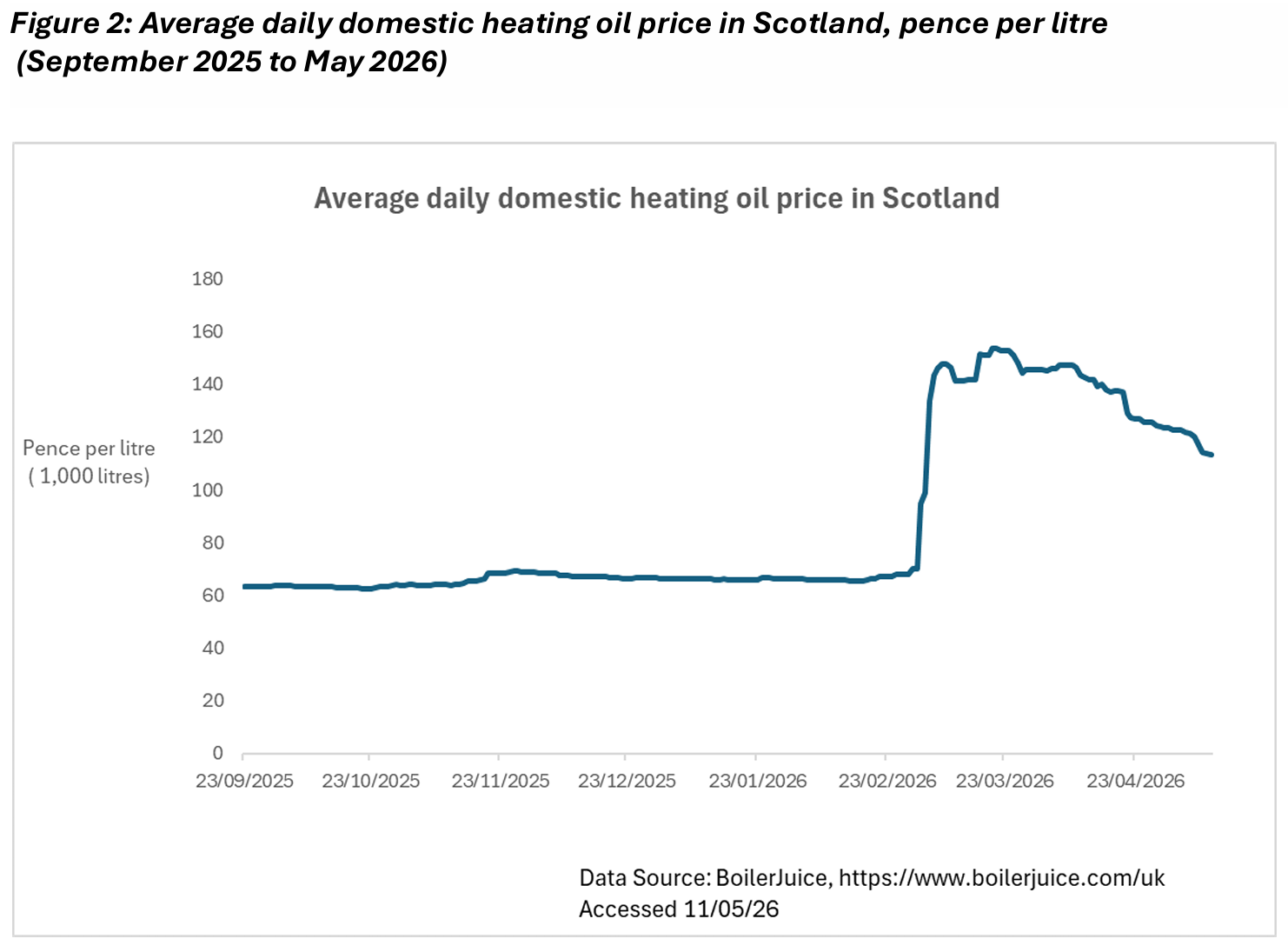
The remaining adjusted net income must be at least 90% of the UK Minimum Income Standard (MIS) to be considered an acceptable standard of living, with an additional amount added for households in remote rural, remote small town and island (RRRSTI) areas. The 2024 Scottish House Condition Survey (SHCS) estimates that 28.7% of Scottish households are currently affected.
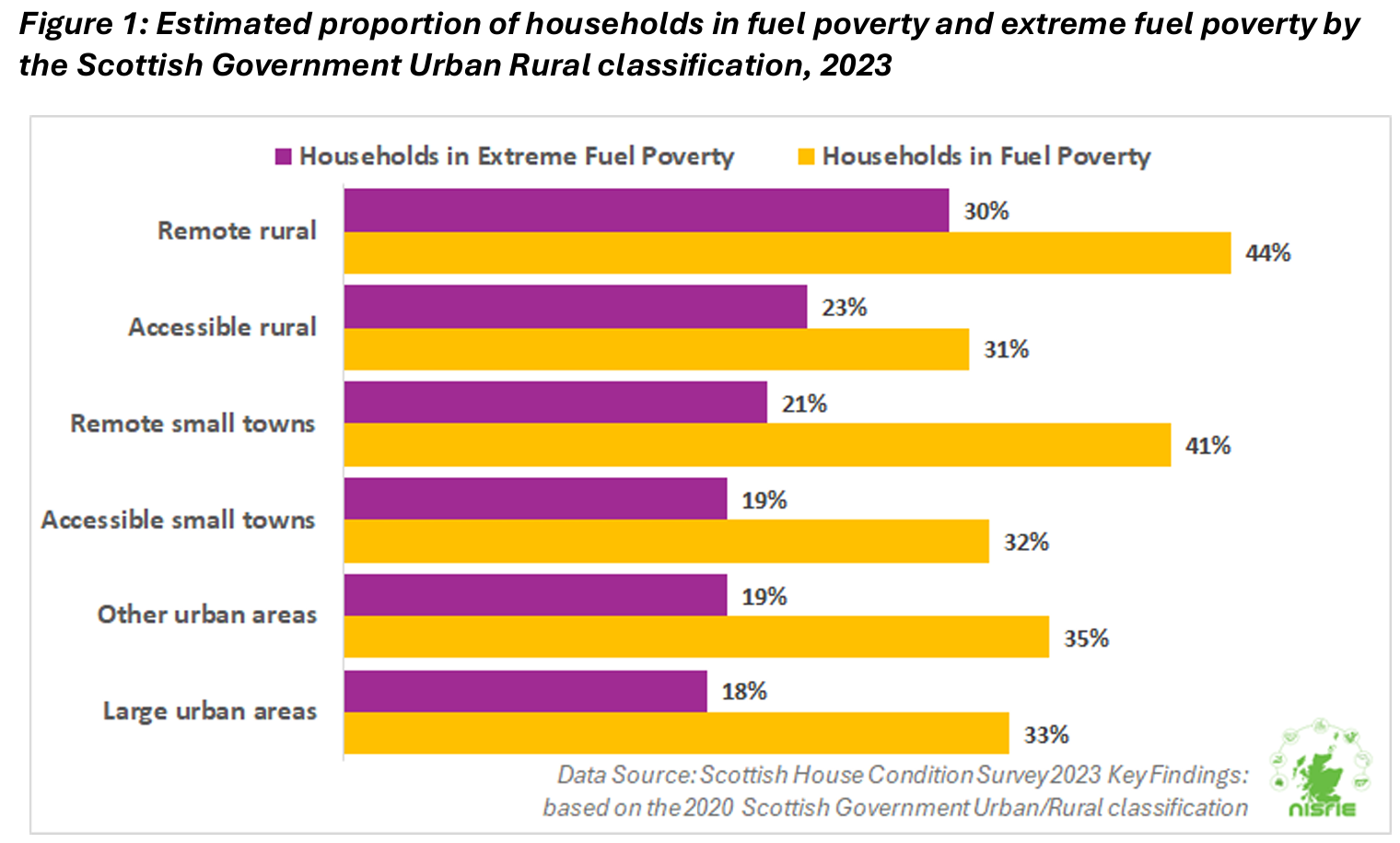
Our 2025 Rural & Islands Insight Report explored fuel poverty levels across Scotland in detail. The analysis (Figure 1) highlighted that 44% of households in remote rural1 areas experienced fuel poverty in 2023 whilst 30% experienced extreme fuel poverty. Latest data for 2024 reveals fewer households in fuel poverty in remote rural areas (38%) but more in fuel poverty in remote small towns (47%). Given the limited access to the gas grid in these areas, it is unsurprising that this pattern of fuel poverty remains a major concern for Scotland’s rural and island communities.
To put the recent price increases in context, the Office for National Statistics (ONS) publishes statistics on the monthly average price of heating oil per 1,000 litres in the UK, covering the period from July 2011 to January 2025. The data illustrates the significant price volatility over time, particularly the spike following the Russian invasion of Ukraine in February 2022. At a UK level, heating oil rose from 69.6 pence per litre in February 2022 to 101 pence per litre in March 2022, before reaching a peak of 111 pence per litre in June 2022, exposing the vulnerabilities of many rural communities in Scotland and across the UK to external shocks to global oil markets. Prices then started to fall again gradually from July 2022.
BoilerJuice reports daily heating oil prices across the UK, including data specifically relating to Scotland. Figure 2 shows the rapid increase in heating oil prices since the conflict in the Middle East began, with an average price of around 66 pence per litre between 23 September 2025 and 28 February 2026. As a result of the on-going conflict in Iran, prices rose above 70 pence per litre on 1 March 2026, with a jump to 94.76 pence per litre on 3 March. Prices peaked at 153.74 pence per litre on 20 March 2026 before decreasing, but on 11 May 2026 remained above 113 pence per litre.
As well as the increased prices, concerns have been raised for households purchasing heating oil, subject to investigation by the Competitions and Markets Authority. These relate to placed orders being cancelled, with much higher prices quoted for new orders and increased prices for automated deliveries when tanks reach a trigger level of heating oil. Moreover, minimum order sizes have also been introduced by many companies that lower-income households are most disadvantaged by.
Rising heating oil prices are of greater concern to rural and island communities in Scotland (compared to urban areas) as gas is generally the cheapest way for households to heat their homes in Scotland and is the predominant heating source in Scotland’s towns and cities. However, the gas distribution network does not extend to most rural and island communities (as reported in our recent Rural and Islands Insights Report 2025). The Scottish Government reports that 12% of households are not connected to the gas grid, and there is no national gas grid network on most of Scotland’s islands, including Orkney, Shetland and Na h-Eilean Siar. This means that many households rely on alternative fuels to heat their homes, often heating oil. 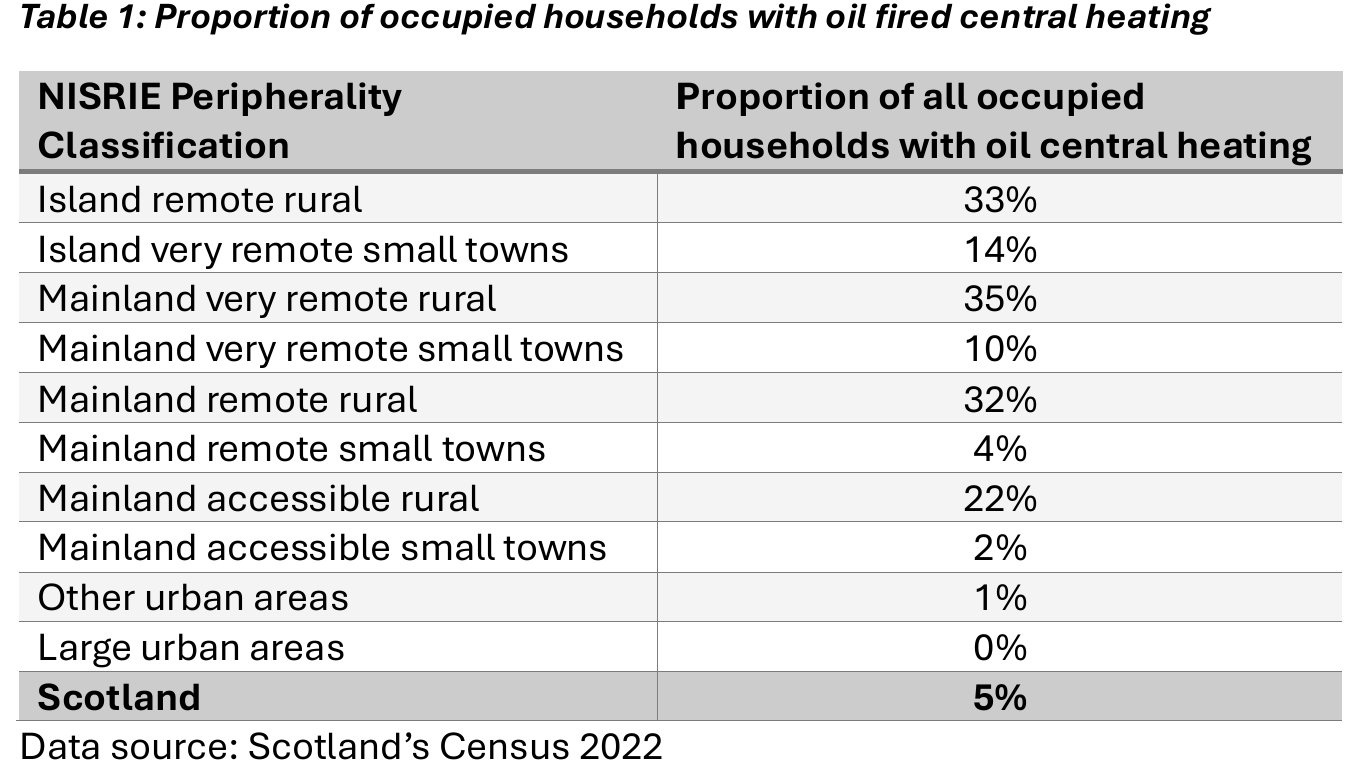
Data from Scotland’s Census 2022 revealed that approximately 127,600 or 5% of households use heating oil as a heat source, acknowledging that households may have access to more than one type of heating. Indeed, those in remote rural island (14%), very remote rural mainland (14%), and remote rural mainland (12%) areas reported the highest prevalence of multiple heating systems in households, compared to the Scottish average of 6%.
Overall, households using oil central heating represent around 5% of all households in Scotland, but this rises to as much as 35% of households in very remote rural areas of mainland Scotland. Table 1 shows the higher prevalence of oil central heating used in rural and island areas of Scotland, with 33% of households in remote rural island areas and 22% of households in accessible rural areas of mainland Scotland using it. In contrast, almost no households in large urban areas (0% after rounding) and only 1% of households in other urban areas rely on oil central heating.
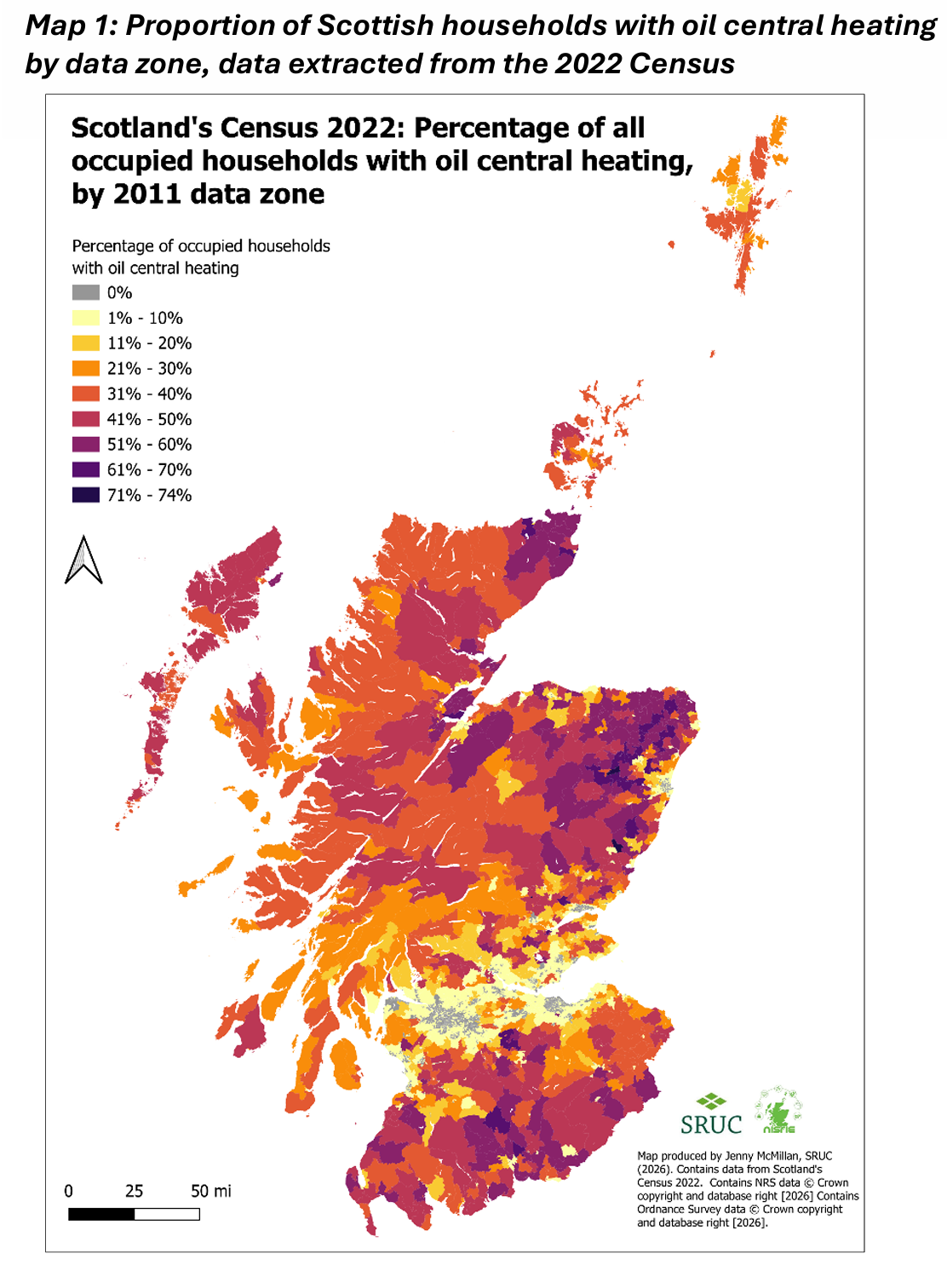 Map 1 details the proportion of occupied households with oil central heating by data zone in Scotland (from the 2022 Census), with darker shading illustrating areas with higher usage. High concentrations are evident in parts of Aberdeenshire, the Highlands and some areas in the South of Scotland. In some parts of Perth and Kinross and Aberdeenshire, up to 74% of occupied households within data zones use oil central heating. Usage of oil central heating as a main heating source by rurality was at 29% for dwellings in both island very remote rural and mainland remote rural areas, along with 28% in mainland very remote rural areas in 2024 (using Energy Performance Certificate (EPC) data).
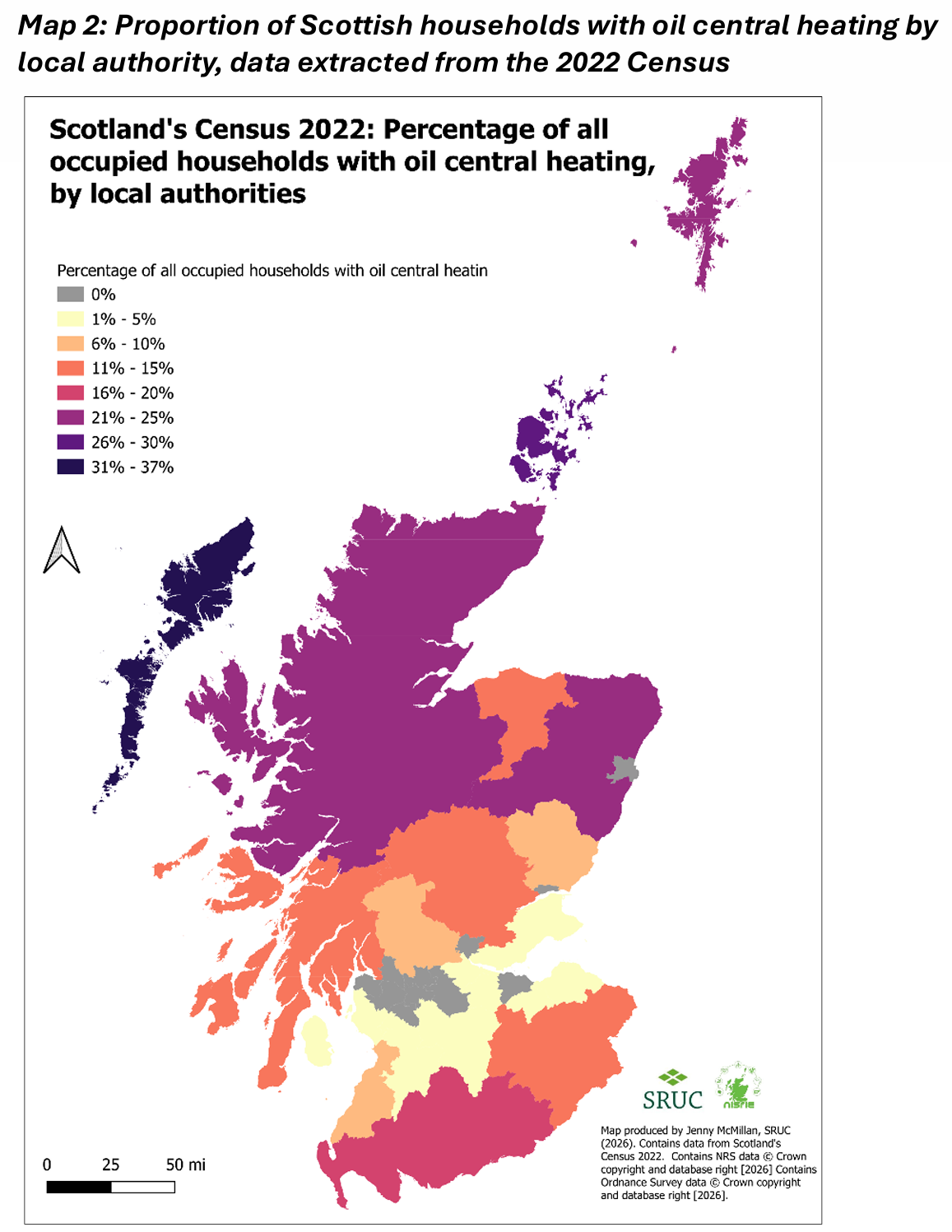
At local authority level (see Map 2), 2022 Census data shows that Na h-Eilean Siar had the highest proportion of households using oil central heating (30%), followed by Orkney Islands (28%), Shetland Islands (at 23%) and Highland (22%). Rates were also relatively high in Aberdeenshire (21%) and Dumfries and Galloway (17%).
In response to rising energy prices in 2022, the UK Government provided support measures for households using alternative fuels, including heating oil, coal, LPG and biomass in the form of a £200 payment. The Institute for Fiscal Studies estimates that the overall package of energy support in 2022-2023 and 2023-2024 cost nearly 3% of UK GDP, showing the scale and expense of intervention.
A key concern remains that, unlike domestic electricity and gas, heating oil is not subject to a regulated price cap by Ofgem. In an announcement on 16th March, the UK Government set out its aim to introduce regulations for the heating oil sector and the launch of a support package of £50 million for low-income households relying on heating oil. This support package allocated £4.6 million to Scotland, and the Scottish Government announced an additional £5.4 million of funding which will support low-income and vulnerable households using heating oil and LPG. The support can be applied for through Advice Direct Scotland.
 The Scottish Government aims to decarbonise heat in buildings by 2045, and there are approaches and investments in place to improve energy and heating resilience of rural and island homes, such as the Home Energy Scotland Grant and Loan Scheme. This provides financial support to homeowners across Scotland to install clean heating systems and improve energy efficiency, including a ‘rural uplift’ of £1,500 for households located in remote rural and island areas and accessible rural areas out-with the gas distribution network. However, investment costs may still be a barrier for many rural households, and although the government support announced will be welcomed, recent global events have exposed just how vulnerable rural household budgets are to external shocks.