


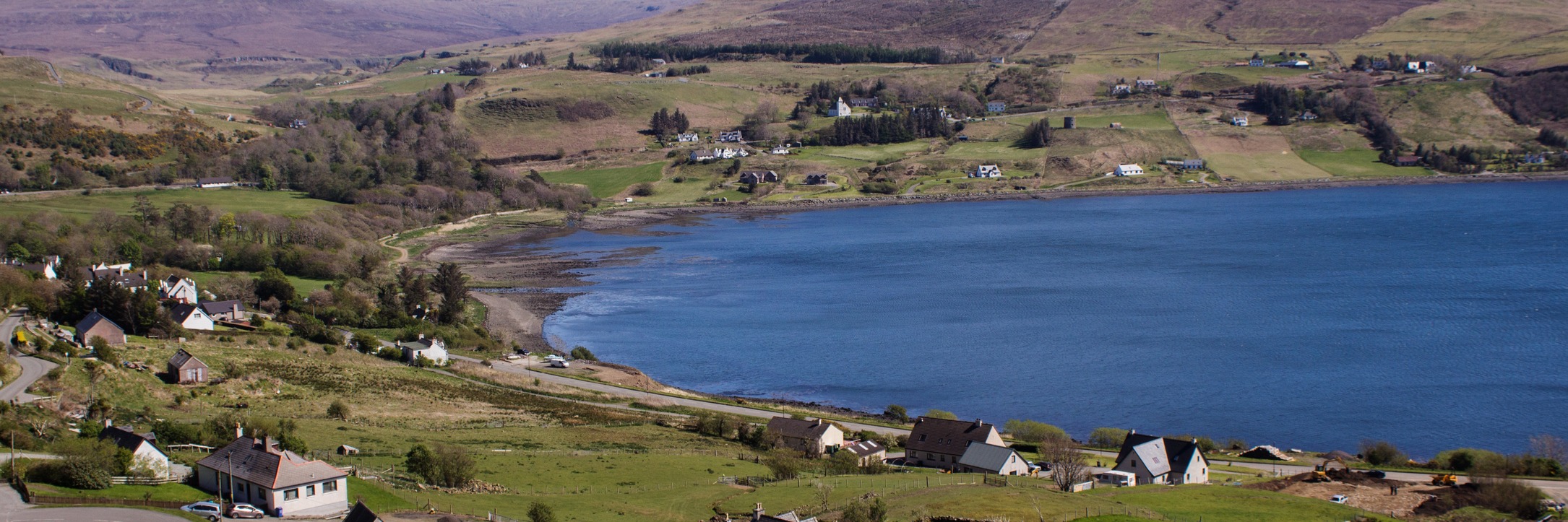
Sustaining Care in Rural and Island Scotland: Reflections on the First Months of My PhD Journey by Emma Margaret Currie
What happens when the people who care for our communities are themselves in short supply? In many rural and island areas, this question is not a distant concern but an emerging reality shaping everyday life. In October, I began my PhD at SRUC, exploring workforce shortages in the care economy across rural and island communities in Scotland – a topic central to the sustainability and future of these economies. My research aims to generate evidence on how rural and island communities understand, experience, and sustain their local care economies amid workforce pressures and demographic change.
Starting a PhD is as much about navigating new environments as it is about refining research questions and literature reviews. My PhD journey started with an induction day at SRUC Edinburgh, where I met my cohort, whose projects range from horse behaviour to soil quality and crop yields. As a social scientist, being part of an interdisciplinary environment has broadened my perspective and challenged me in new ways. In the first weeks, I completed mandatory training, started a broad literature search, and had my first supervisory meeting with my supervisors, Dr Francis Naab, Dr Jane Atterton, and Prof. Andrew Barnes. By November, I had started regularly attending training workshops through the Scottish Graduate School of Social Science (SGSSS) and the University of Edinburgh’s Institute for Academic Development, and the Rural Geography Research Group’s coffee mornings. I also participated in a practice presentation session at SRUC Aberdeen, where my cohort shared early research ideas and received constructive feedback. In December, I submitted my ten-week report, which allowed me to have in-depth discussions about my research plan with my supervisory team and thesis panel.
Understanding care systems requires moving beyond theory and into the lived realities of communities of practice. Thus, I started connecting with stakeholders across the care and rural policy landscape and had informal conversations to understand the key issues across the sector. I also joined the Improvement Service’s Rural Child Poverty Network and participated in sessions hosted by the Coalition of Care and Support Providers in Scotland and Simon Community Scotland at the SCVO Gathering on social care implementation gaps, and co-production and lived experience. Additionally, I attended the London School of Economics’ Lionel Robbins Memorial Lecture series on immigration to gain insights into the role of migrant workers in addressing labour shortages.
Momentum has been building steadily, with opportunities to share my research ideas and design potential impact pathways from my PhD research. March has been a particularly busy and rewarding month so far. I was delighted to learn that I had been shortlisted for the second round of the SGSSS Impact Competition, with the winner to be decided by a public vote from 17 April to 4 May. A significant milestone also came with my first conference presentation at the 2026 Countryside and Community Research Institute Winter School. Additionally, I attended the final meeting of the Scottish Parliament's Cross-Party Group on Islands, a Scottish Islands Federation seminar on return migration and island connections led by Dr Kirsten Gow, and the Scottish Research Cultures Showcase in Edinburgh.
Looking ahead, the next stage of the journey shifts from explorations to a deeper focus on my literature review and sharing my research ideas to a wider audience. I am preparing for the SRUC Postgraduate Research Conference, the SGSSS Collaboration and Impact Showcase, and the Scottish Land and Estates Conference. Alongside these events, I will look to complete a draft of my literature review, begin preparing my ethics application, and undertake a scoping study.
Although I am still at the beginning of my PhD journey, the first few months have already provided invaluable experiences and learning opportunities. Even at this early stage, it is very clear that research in this space is not just about evidence, but about people, place, and purpose. I have had engaging conversations with stakeholders, met inspiring colleagues and researchers, and made new friendships. I am constantly reminded of how fortunate I am to study at SRUC, and be a part of the team at the Rural Policy Centre, where important research on Scotland’s rural and island communities is already taking place, and publications such as the 2025 Rural and Islands Insights Report and Demographic Change and Out-migration in Rural and Island Scotland are shaping national conversations around data availability and gaps, and innovative policy responses. I am excited to build on this momentum and continue developing research that contributes meaningfully to understanding and supporting rural and island care economies. Sustaining care in rural and island communities is not only a research question, it is central to the future of these places.