Scotland's Census: Working at 65+
 This report aims to provide insights into the levels of economic activity in Scotland’s 65 years old and over (65+) population, the type of activity and the sectors they are engaged in using Scotland's Population Census data. This report is part of the Novel Insights on Scotland’s Rural and Island Economies (NISRIE) project as part of the Scottish Government's Environment, Natural Resources and Agriculture strategic research programme 2022-27. The report can be downloaded directly from the link at the bottom of this page.
What were we trying to find out?
The research explored the recent 2022 population census alongside data from the 2011 and 2001 census to ascertain if patterns of economic activity in this age group have changed as a result of changing pension ages, life expectancy and general societal change. The research focused on assessing the spatial and sectoral dimensions of economic activity in the older population, particularly in island and very remote mainland areas, where previous NISRIE research highlighted differences.
What did we learn?
The number of people aged 65 year old and over has continued to increase over recent decades, particularly in rural and island areas. However, official statistical reporting of populations by age group (65+) no longer mirrors the state pension age. Analysis of the 2022 Census points to these areas having some of the highest rates of economic activity in the aged 65+ population.
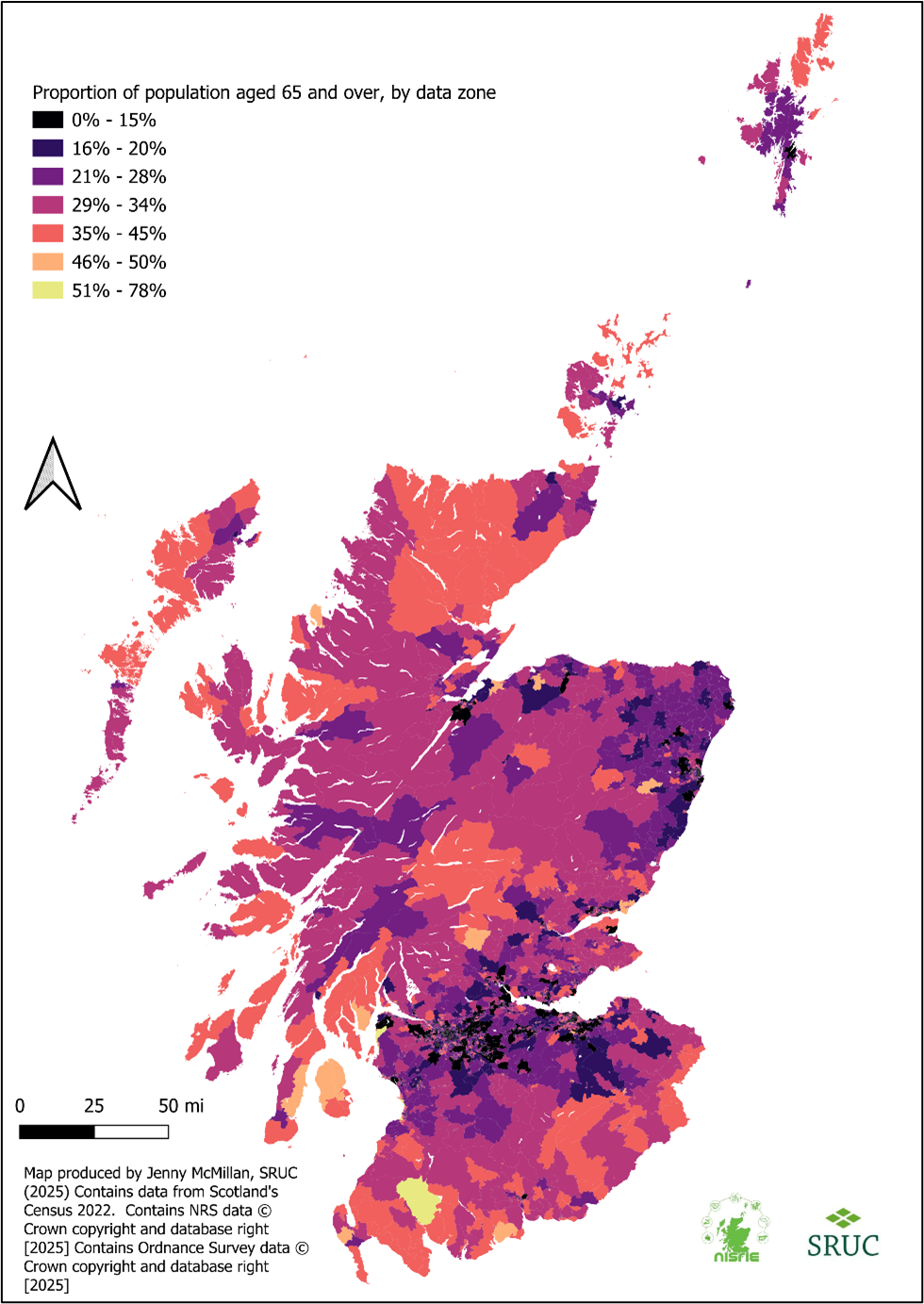
- Economic activity rates ranged from 9% in urban areas to 16% within island populations. In some rural places, up to 28% of the 65+ population were economically active.
- Self-employment past the age of 65 was particularly high in parts of rural and island Scotland, with this group being much more likely to be self-employed than any other age group: Nationally 31% of economically active people aged 65+ were self-employed compared with 16% for people aged 50-64.
- 55% of people aged 65+ were working 31 or more hours a week, with those working in Agriculture, Forestry and Fishing working the longest hours. Nearly 50% of self-employed people and 24% of employees aged 65 and over in the Agriculture, Forestry and Fishing sectors worked 49 or more hours per week.
- The old-age dependency ratio (the ratio of the 65+ population over the economically active working age population) was highest in the islands and remote rural parts of Scotland. An alternative ratio assessing the economically inactive aged 65+ population against all economically active people over the age of 16 (including those over 65) shows lower spatial variation in some rural and island locations.