Orkney Greening Support
In an extension to the Islands Agriculture Report published in 2024, the Orkney Islands Council and the Orkney Local Action Group commissioned this work to assess the implications of significant changes to Scotland’s agricultural ‘Greening’ support regime in the form of Ecological Focus Area (EFA) requirements and their impacts on Orkney’s farming and crofting systems. The report can be downloaded directly at the bottom of this page.
From 2026, the Scottish Government will remove long-standing derogations that have exempted most Orkney businesses from at least some EFA obligations. These changes, aligned with the transition to a four-tier agricultural support framework, are expected to substantially affect land management practices. Official data and three farm case studies are used within this report to illustrate impacts.
Key Findings
- New Environmental Conditionality: Following the introduction of the 4-tier approach to future agricultural policy through the Agriculture and Rural Communities (Scotland) Act 2024, the Scottish Government aim to introduce new Tier 2 ‘Enhanced’ conditions for ‘Greening’ support (worth £139m in 2021) from 2026. Proposed policy changes reflect multiple, and shifting, priorities reflected in the 2024 Act. They also reflect a need to transition to different forms of support with a greater recognition of the different types of public contributions from land management, demonstrating value for money within budget constraints.
- Extending Greening Conditionality: Changes to the Scottish Suckler Beef Support Scheme for 2025 was the Scottish Government’s first step to introduce enhanced environmental conditionality. Newly announced changes to future Ecological Focus Area requirements will expand the number of businesses and areas of land where environmental measures are undertaken, aligning with the Scottish Government’s objectives. Changes include updated compliance requirements for those currently undertaking Ecological Focus Area options, but also introduce new compliance requirements for grassland-dominated farms and crofts that have, to date, not had to comply due to historic grassland derogations. The analysis presented in this report offers some insights into the potential magnitude and patterns of resulting change
- Major Policy Shifts in EFA Rules. From 2026, all farms and crofts with more than 15 hectares of arable and temporary grassland must allocate 5% of that land to EFAs, possibly increasing to 7% in 2027. Longstanding exemptions for farms with smaller arable areas will remain, but historic derogations for grassland-dominated systems will be removed, resulting in a dramatic expansion in the number of Orkney farms subject to EFA rules and hence compliance burdens (in terms of both opportunity costs and resource costs). This results in the proportion of Orkney farm businesses complying with and therefore contributing via EFA management expanding from c.1% to c.35%.
- Category definitions (‘agri-semantics’). A blanket application of new EFA requirements across the existing three payment regions risks attaching the same obligations to very different payment rates depending on context. This suggests that some refinement of categories may be needed to distinguish between (e.g.) permanent grassland in different locations, or indeed different vintages of temporary grass.
- Incompatibility of EFA Options with Orcadian Conditions. Many existing EFA measures were developed with arable cropping systems in mind and are ill-suited to Orkney’s grassland-based systems. Biophysical constraints and infrastructure limitations restrict practicable EFA options (a traffic light assessment suggests mostly red and amber).
- Differences in Guidance Interpretation: It is apparent that there are various differing regional interpretations of the Scottish Government’s guidance notes on EFA Greening measures. For example, use of spring barley (SB) undersown with grass that is then used for silage is considered by some officials and agents as eligible as an EFA catch-crop (EFACC) but considered ineligible by others, with the latter regarding the correct crop-code to be Arable Silage for Stock Feed (ASSF) if the intent is to use the crop for silage. Scheme managers have confirmed that guidance notes will be updated to improve clarity. To further aid interpretation and avoid ambiguity, it is suggested that a short Frequently Asked Questions (FAQ) section be included at the end of each EFA option guidance note, rather than the long separate list of FAQs covering all EFA options that is currently used. Disproportionate Impact on Orkney Businesses. Orkney has one of the highest shares (c.60%) of temporary grass within ‘arable’ land (60%), reflecting rotational practices not well captured by the current EFA design. The new rules place the same obligations on grass-dominated systems as they do on annually cropped land, despite differing environmental baselines and operational contexts.
- Future Conditionality on Permanent Grassland (PGRS). The Scottish Government has signalled its intent to review opportunities to extend EFA-type requirements to PGRS, which constitutes a large share of Orkney’s agricultural land. Analysis shows that, depending on threshold levels, between 50% and 80% of Orkney’s 645 PGRS-claiming businesses could be required to comply, potentially affecting over 2,800 hectares (6,8% of PGRS) if adopted. Alternative thresholds or adjusted EFA weightings may better align with Just Transition principles and mitigate burdens on small- and medium-sized enterprises.
- Combined Effects of Arable and PGRS EFA: If both arable and PGRS EFAs are introduced at 7% requirement, this could lead to 79% of Orkney businesses having to comply with EFA rules, with 35% having to comply with both arable and PGRS requirements. Combined, up to 3,600 hectares (4.9% of all land claimed for direct support) of EFA would be required. This would be the third-highest regional proportion of total land in EFA behind Fife (6.5%) and Lothian (5.1%).
- High AECS Engagement Creates Risk of Double Funding and Policy Conflict. Orkney has the highest proportion of businesses enrolled in the Agri-Environment Climate Scheme (AECS), with 35% receiving payments in 2021. Given policy overlaps between AECS and EFA measures, this raises potential problems of ‘double funding’ and participation in either scheme, which may undermine overall policy coherence.
- Advisory capacity constraints. The complexity of new rules and their interactions with other policy requirements (including AECS, but also LFASS and coupled support) is likely to increase demand for advisory support. However, advisory capacity is already stretched.
Recommendations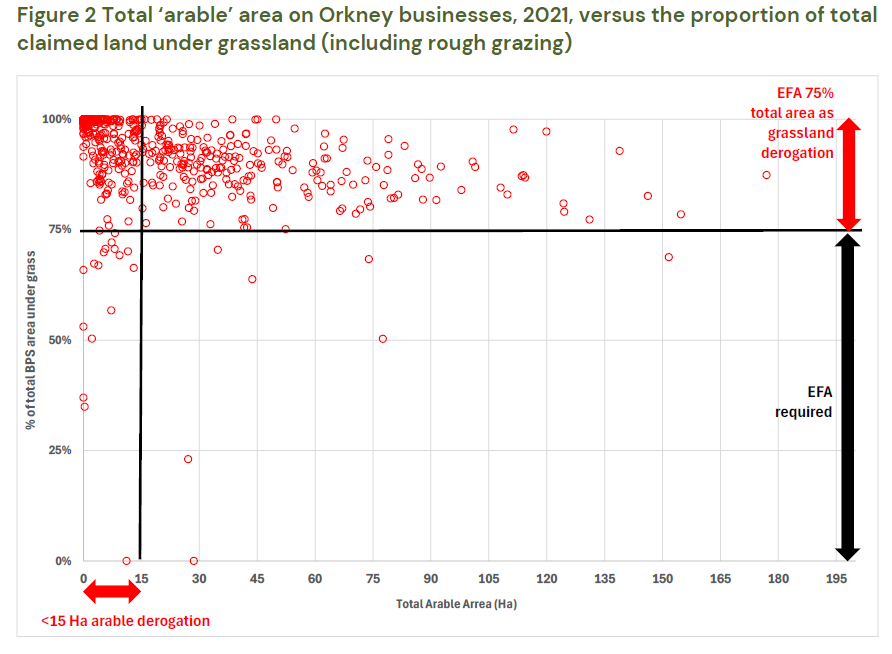
- Tailored EFA design for grass-based systems and biophysically constrained regions like Orkney.
- A refreshed and extended FAQs for greening guidance for each option, particularly given the number of businesses having to comply for the first time in 2026, plus most existing guidance notes have been amended, making compliance more complex for all those currently delivering EFA.
- Policy clarity and coordination between Greening, AECS, and future Tier 2 and Tier 3 measures to avoid compliance duplication and perverse incentives.
- The planned retention of the current 15Ha arable threshold for EFA should be acknowledged as safeguarding smaller producers.
- Phased transition options such as increased derogation thresholds or conditional exemptions for producers with limited ‘arable’ areas above 15 hectares, or where their ‘arable’ land is entirely temporary grass.
- Review of payment structures to ensure economic viability of environmental actions in a changing support landscape.
- Additional advisory support.